Alignment *is* ease
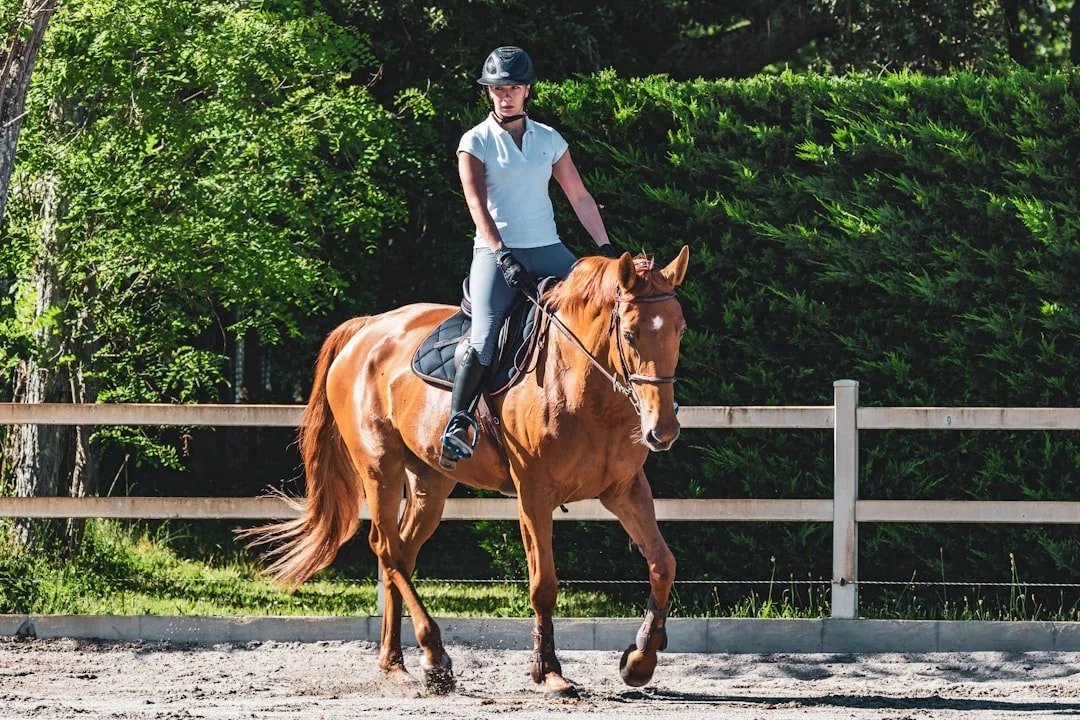
Photo by Philippe Oursel on Unsplash
There’s a word that gets thrown around a lot in wellness and personal development spaces: alignment. It sounds soft. Floaty, even. Like something that happens when you light enough candles or meditate long enough.
But here’s what I know from working with bodies, both animal and human, for over 18 years: Alignment isn’t a vibe.
It’s a structural reality. And when you’re in it, everything gets easier.
The Mechanics of Ease
Watch a horse moving in true collection: every muscle doing exactly its proportional share of work, no part overcompensating for another. That’s alignment in action. The result is power with seemingly no effort. Fluid, almost effortless forward motion.
Now watch that same horse on a bad day: bracing through the jaw, rushing through anxiety, one hip dropped and the other overworking. That’s what falling out of alignment looks like. Everything costs more. Everything is harder.
The same principle applies to us.
When your body is aligned — posture, breath, movement mechanics — physical tasks feel easier than they do when you’re braced, collapsed, or compensating. When your energy is aligned — when what you’re doing matches what you’re genuinely here to do — you can work for hours and feel energized rather than depleted. When your emotions are aligned with your actual truth rather than what you think you should feel, life stops feeling like a battle with yourself.
Alignment, in any system, produces ease.
Why It Feels Wrong at First
Here’s the catch that nobody tells you: The first attempts at alignment often feel terrible.
Not because alignment is wrong for you. But because the muscles required to sustain it — physical, energetic, emotional — are underdeveloped. Weak from years of not being used. And weak muscles fatigue fast.
If you’ve ever tried to correct your posture and ended up more uncomfortable than when you started, you know exactly what I mean. Or tried to work in a new way that felt more “you,” only to hit a wall of exhaustion and have your brain immediately suggest that maybe the old way was fine actually.
The brain, bless it, is wired for efficiency. It reads fatigue as danger and discomfort as evidence of a bad decision. When you’re building new alignment, it will absolutely try to send you back to what you were doing before — not because the old pattern was good, but because it was familiar.
The Real Practice
Building alignment isn’t a sprint. It’s a conditioning process.
You wouldn’t go to the gym for 15 hours and expect to have built all the strength you were missing. Your body would give out long before you got there. The way it actually works is short sessions, repeated consistently, with rest in between. Over time, what once felt impossible becomes your new normal.
The same is true of energetic and emotional alignment work.
The practice isn’t about pushing through until you get it right. It’s about:
Short sessions. Real rest. Repeating anyway.
The goal isn’t to white-knuckle your way into a new pattern. It’s to get enough repetitions of the right pattern that your system starts to recognize it as home.
Tension Is the Warning Bell
In riding, we talk a lot about tension as information. The moment you feel resistance or bracing under you, that’s data — not punishment. Something has gone offline. Maybe the terrain shifted. Maybe the ask changed. Maybe there was a distraction. Whatever it was, the tension is telling you that alignment has slipped.
The same is true in our bodies, energy, and emotional lives.
The moment you feel tension creeping in — physical tightness, that anxious hum, the emotional churn that doesn’t quite make sense — that’s your warning bell. Not a verdict. Just information.
And the faster you can catch it, the less work it takes to come back.
A small correction early is always easier than a major correction later.
Conscious Choice vs. Default Mode
Here’s where it gets interesting: every action you take is either moving you toward greater alignment or further away from it.
That’s not meant to be heavy. It’s meant to be useful.
When you’re conscious of that — when you’re tracking your own patterns, noticing the tension, recognizing the fatigue — you get to choose. Different posture. Different response. Different use of your energy.
When you’re not conscious of it, you’re on autopilot. And autopilot, for most of us, is running old compensatory patterns that got us through harder times but aren’t built for where we actually want to go.
The invitation isn’t to be perfectly aligned at all times. That’s not how any of this works. The invitation is to keep returning. To recognize the drift. To make a different choice when you catch it.
Returning is the practice. Not arriving.
What This Looks Like in Real Life
Alignment doesn’t look the same every day — and this is the part that trips people up.
Just like a body has to adjust its balance constantly to navigate changing terrain, your energy and emotional alignment will require daily recalibration. Some days the work will feel effortless. Some days you’ll be rebuilding from scratch after a hard night, a difficult conversation, a week where you pushed past your actual capacity.
The practice isn’t about hitting a fixed state and staying there. It’s about developing enough body literacy — physical, energetic, emotional — that you can find your way back more quickly each time.
That’s what all this work is building. Not perfection. Faster recovery.
This whole-system approach is at the heart of what I do when I work with animals and their people — if that resonates, click here to connect with me.